You are the Marketing Manager. You are in your weekly meeting when your CEO or Sales Director suddenly asks you:
"Do you have any data on Competitor X? What exactly are they doing?”
At that precise moment, you have two options. The first is to mumble something about the impressions you got while scrolling through their Instagram feed. The second is to ask for 24 hours, clear your schedule and begin the exhausting, chaotic process of manually collecting screenshots and fragmented metrics.
As we know, the ability to manage data and present clear scenarios to management is a fundamental part of the marketing team’s role. Below, we will look at how to build and present a competitive benchmark, and how automation can save you from the anxiety of staring at a blank page.
The limitations of manual competitive benchmarking
A marketing manager is not just a technical specialist: relationships are also a key part of the role. When you present a strategy or request additional budget for a new campaign, the Board needs reassurance and solid, indisputable figures.
Presenting a competitor analysis built “by hand” comes with structural flaws that are immediately obvious to senior executives:
- Partial and inconsistent data: you may have counted followers on Facebook, but you have no way of knowing how many Google Ads campaigns your competitors have launched in the past 30 days. The picture is incomplete.
- Reports that are outdated before they are even finished: collecting data manually takes days. By the time you project your slide in the meeting room, your competitor’s ads may already have changed.
- The “So what?” effect: presenting an Excel spreadsheet full of raw numbers often triggers the classic CEO response: “Okay, but what do we actually need to do today?” The data has not been translated into strategic action.
The result is often a set of documents that are too long, too complex and lacking clear guidance on what to do next. A marketing manager’s goal should be the exact opposite: clarity, evidence and action.
How to structure a competitor analysis that stands up in the boardroom
To be effective in front of C-level executives, your competitive benchmark needs to move beyond vanity metrics and focus on business-oriented indicators. Here is the ideal four-step framework:
1. The executive summary
Start with the conclusion. The first slide or first page of the report should summarise the current situation in just a few lines. Who is the market leader this month? Who is accelerating the most? What is the biggest threat, and what immediate opportunity should you seize?
2. Advertising pressure
Executives care about investment. Rather than showing the number of likes, you need to demonstrate who is paying to gain visibility. Show how many paid campaigns your competitors have activated on Meta and Google, which messages they are focusing on and which formats they prefer.
3. Frequency and positioning
How often are your competitors publishing? Are they updating their websites more frequently than your company? Have they launched new products, services or landing pages in recent days? Which topics are they talking about most?
4. The action plan
The final step is where the Marketing Manager delivers real added value. Based on the data collected, present concrete actions. For example:
“We need to launch a local Search campaign to counter Competitor B’s initiative, with an additional budget of €2,000.”
How Strateego.ai transforms your reports
Collecting and presenting these four areas manually every month is exhausting and drains valuable operational resources. Strateego.ai was created to automate this process.
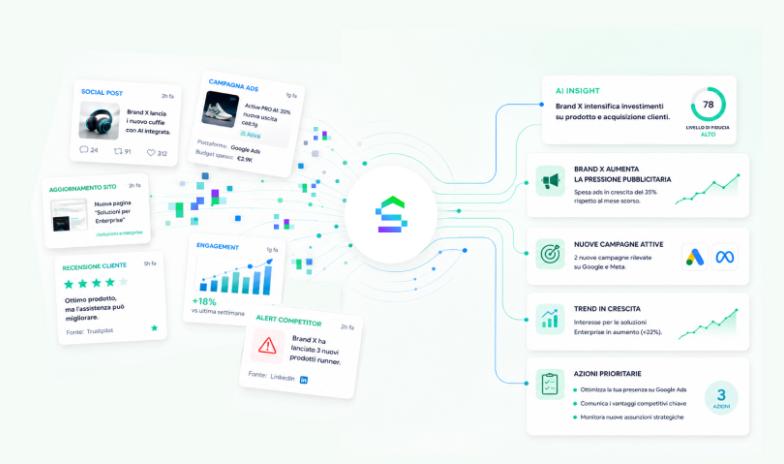
Strateego allows you to stop searching for data and start presenting it. The platform automatically monitors the social media, ads and websites of brands in your industry 24/7.
When management asks you “the question”, you already have the answers ready and formatted:
- Competitive Index: show a concise score from 0 to 100 that measures exactly where your company stands against its competitors at that moment.
- Centralised Ads Activity: instead of pasting outdated screenshots, open a dashboard showing your competitors’ active Meta and Google Ads campaigns in real time, all visible at a glance.
- AI-powered Cross Analysis: Artificial Intelligence simultaneously analyses competitive pressure and creates a content strategy and actionable recommendations based on industry data. All you have to do is approve them.
What’s more, thanks to native integration via the MCP protocol, you can bring Strateego data directly into the AI you use every day, such as ChatGPT, Claude or Gemini.
Your preferred AI agent becomes your strategic right-hand assistant: in just a few seconds, it can develop briefs, action plans and impact analyses based on fresh, real market information verified within the past 24 hours.
A paradigm shift: from execution to strategy
Imagine your next meeting. Instead of asking for time to collect fragmented information, you present real-time data.
You summarise the situation by saying:
“Competitor A has just launched four new Google Ads campaigns for lead generation. Based on industry conversion data, here is our counterstrategy.”
You are no longer presenting assumptions or irrelevant charts. You are using Competitive Intelligence to take control of the market. And the perceived value of the marketing department within the company takes a decisive step forward.
Monitor your market and start your 15-day free trial.