WimTV is an Italian platform that lets companies and publishers create their own white-label Web TV, managing video content and monetizing their archive while keeping full control over their content.
We interviewed Isabella Chiariglione, who handles marketing and communications at WimTV — from defining positioning strategies to the day-to-day management of social channels and campaigns — to understand how using Strateego.ai has changed the way she monitors competitors and the market.
Can you introduce yourself and briefly tell us what you do at WimTV, particularly on the marketing and communications side?
Of course. Hi everyone, I'm Isabella and I handle marketing and communications at WimTV. My role mainly involves managing corporate communications, creating content, defining positioning strategies and telling the story of our platform to customers and potential customers. Since we're a relatively small company, my work is very cross-functional: I handle both the strategic side, such as identifying markets and the messages to communicate, and the operational side, such as managing social channels, campaigns and content.
How did you work before you came across Strateego? What method did you use to monitor competitors and the market?
Before using Strateego, monitoring was definitely more manual and fragmented. We looked for information on competitors through their websites, social media, newsletters and public communications, but it was an activity that took a lot of time and didn't always allow us to have a complete, systematic view of the market. The risk was focusing mainly on what we were already keeping an eye on, without always managing to catch new movements or new opportunities.
When you started using Strateego, I imagine you had some expectations. What did you expect it to solve? What was the biggest problem you were running into with the way you worked before?
What interested us most was the possibility of having a more structured view of the market and of our positioning relative to competitors. As a small company, it's very important for us to be able to make decisions based on concrete data and information, avoiding investing time and energy in activities that may not be a priority. So we expected a tool that would help us not only to monitor the market, but also to spot new opportunities and practical suggestions to turn into actions.
How long have you been using Strateego, and how much time do you estimate you save per week compared to how you monitored competitors before?
We've been using Strateego for a few months now, and one of the main advantages is definitely the time savings. Before, many tasks required manual research and the work of gathering and comparing information. Today we have a more immediate and organized overview, which lets us focus more on interpreting the data and on the actions to take, rather than on collecting the information, which now happens in a much faster and more structured way.
Could you give us a concrete example of an email alert that notified you of a change in the market, a competitor's move, or a spike in activity? What did you do after receiving it?
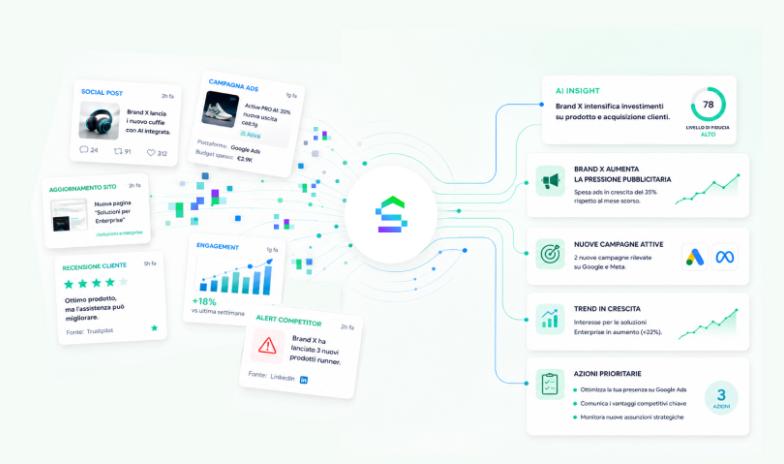
One of the things we appreciate about the alerts is precisely the fact that we don't have to constantly check all the sources, but are informed when something relevant happens. This has helped us above all to keep our attention high on competitors' movements and their communication activities, allowing us to dig deeper into certain topics and constantly compare them with our own strategy.
Was there ever a time when Strateego's data made you change or correct a decision you'd already made?
Yes, definitely one of the most concrete examples concerns advertising. Before using Strateego we had never invested in social campaigns because, being a small company, we tended to weigh every investment very carefully and considered these activities not a priority. Among the suggestions that emerged from the analysis, however, was the opportunity to experiment more with this channel: we decided to try it and discovered that, with a targeted strategy, it could be a really effective tool for increasing visibility and engagement for WimTV.
Looking at the Social Overview, did you identify a timing or a format that works better for your audience, and adjust WimTV's scheduling accordingly? Can you tell us about it?
Before using Strateego we had a more fragmented view of content performance: we looked at the individual social channels, but it was harder to get an overall picture and understand the patterns. With the Social Overview we started to observe more closely which content generated the most interest and engagement. For example, we noticed that content more tied to concrete use cases, such as customer stories and deep dives into the streaming world, tended to get a better response than purely promotional content. This led us to give more space to editorial content, like WimTV Stories and deep dives into the future of television, and to educational content about streaming. In short, we changed our scheduling by focusing less on the product and more on the value WimTV can bring to users.
Regarding Ads Activity, did you discover anything about the ads that led you to change a campaign already underway?
Yes, especially in this case it helped us understand that the message we think is most effective isn't always the one that works best for the audience. We used this data to compare different creatives and messages and understand which ads generated the most interest, gradually adjusting the campaigns that were underway. In particular, we realized that messages oriented toward the user's problem (for example, creating a web TV, managing video content, monetizing your archive) worked better than communication that was too technical about the platform's features.
The Competitive Index: can you tell me about a moment when a change in the score, up or down, prompted you to take concrete action?
The Competitive Index gave us above all a greater awareness of WimTV's positioning relative to competitors. When we saw the changes in the competitive comparison (in our case, growth) we dug deeper into which aspects were influencing the market's perception: the content published by competitors, the frequency of communication, new services or positioning. This prompted us, for example, to work harder on communicating our distinctive elements: being an Italian platform, offering a white-label service, allowing customers to keep control of their own content, and providing tools to create true Web TVs.
So the Competitive Index gives you a broader reading than the individual indicators, because it brings together and monitors pretty much all the actions you take. Is that right?
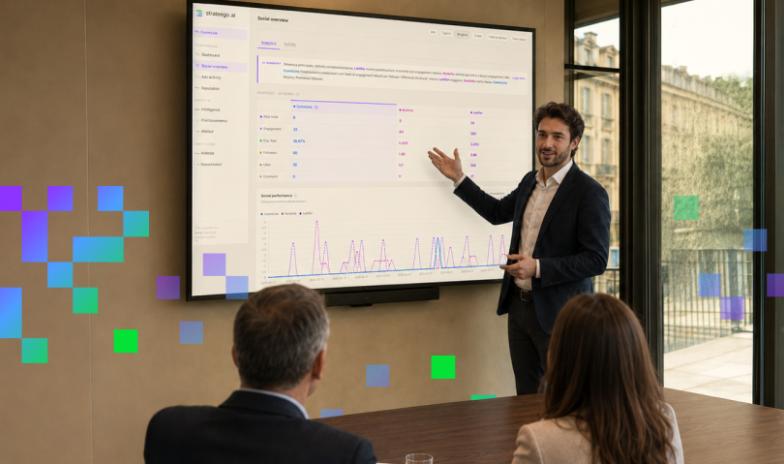
Yes, and visually the platform is very intuitive: it presents an interface where you can see, in chart form, various types of interactions and various types of growth across many different points. It's immediate to see graphically that the actions taken led to a result which, in our case, has always been growth — we hope it continues like this — and this will certainly also help us in the future to make decisions on topics we haven't explored yet, but that we're starting to look into.
Regarding reports: when you generate a report for management, how long did it take you before, by hand, and how long does it take now?
Before, preparing reports took much more time, because I had to gather information from various sources, export data, create comparisons and manually build a readable summary. With Strateego we have a base that's already organized and updated daily, so the time shifts from collecting the data to analyzing and interpreting it. Roughly, what before could take several hours of work can now be prepared in much less time, leaving more room to think about the actions to take.
One of Strateego's flagship features is definitely the MCP integration. How do you use this integration in your everyday work? Can you give a real example of a question you asked through the AI assistant instead of opening the dashboard?
I think it's interesting because it lets you query the data without necessarily entering the platform every time. For example, one question I've happened to ask was: "which content published in the last month performed best on our social channels, and what characteristics do they have in common?" Instead of opening the dashboard, filtering the data and analyzing it manually, I can start directly from a question and get an initial reading of the data that helps me make decisions faster.
In what concrete situations has accessing Strateego's data via MCP (so from ChatGPT, Claude or other assistants you use) saved you a step? Can you give us concrete examples of how you use it, for instance for website content?
Yes, definitely when I have to prepare content or do quick analyses. For example, before writing a post or an article for the site, or even content for an email marketing campaign, I can ask the assistant to analyze which topics are performing best, which subjects are most discussed by competitors, or which content has generated the most interest. This avoids the initial step of manually gathering information and lets me focus on the strategic and creative side.
To wrap up: if you no longer had access to Strateego starting tomorrow, which feature would you miss the most?
The decisions that would probably lose confidence most are those tied to content planning and to benchmarking against the market. In our specific case, Strateego helps us not to rely only on feelings or hunches, but to have confirmation through data: understanding what really interests the audience, how competitors are moving, and where we can improve. The feature I'd miss the most would definitely be the ability to have an aggregated view — to have social, competitors, campaigns and analysis all in one environment.
Strateego's main targets include marketing managers, who often have to deal with a management team that isn't always accustomed to certain kinds of new developments or features like social media. Has it been useful in this sense too, as an extra tool to back up a decision with management or to support your day-to-day work?
Absolutely. What struck me the first time I entered the Strateego platform was seeing the gap we had compared to our competitors: in our case it was about twenty points below the closest competitor. As we made decisions and started the recommended activities, we saw WimTV's score grow fairly quickly relative to the others. This was very useful visually too: while at the start the gap was over 20 points, it has now narrowed to 11, so we've grown a lot in recent weeks. This also helped me put something down in black and white, to show that the actions we took were done with a clear rationale.